
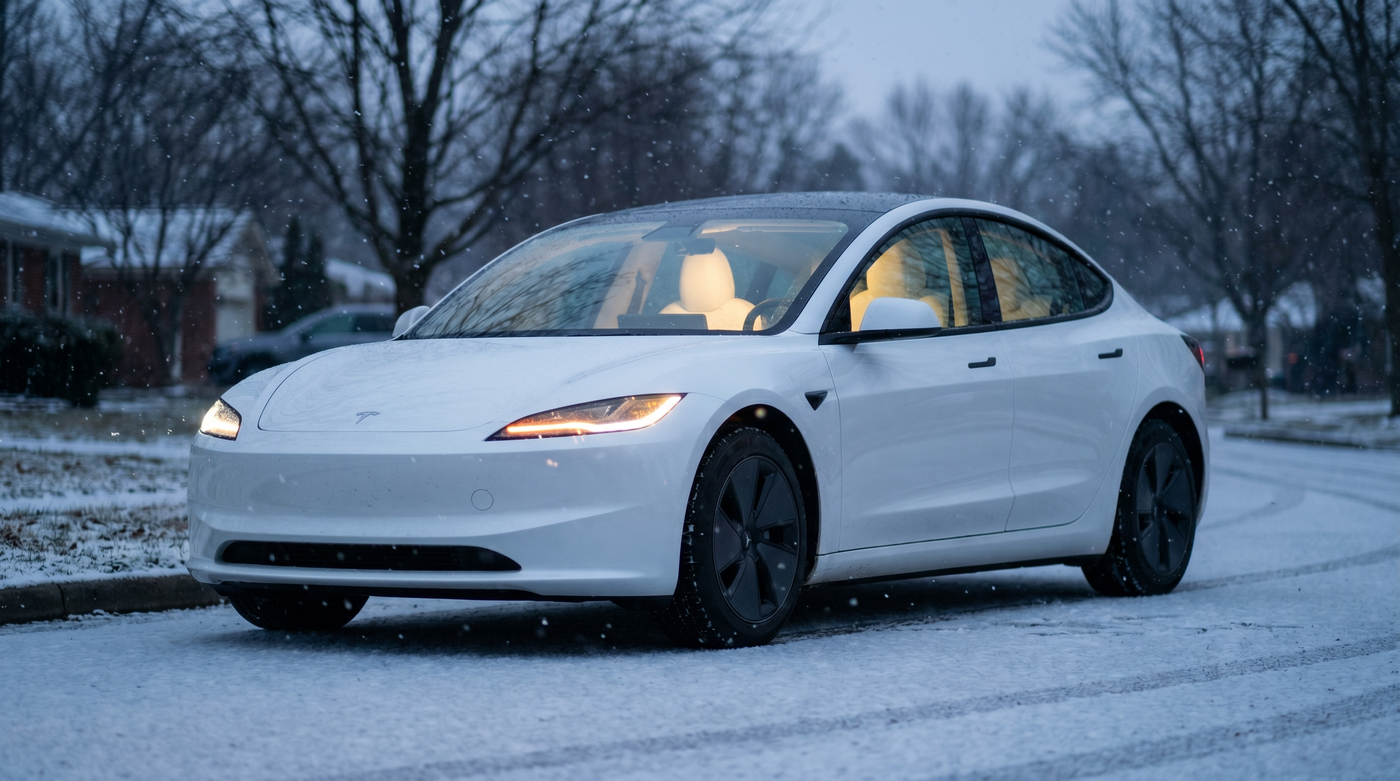

The Model 3 is harder on interiors in winter than the Model Y
This is counterintuitive to people who haven't owned both. The Model Y is a crossover — higher ride height, taller door sills, passengers step up into the cabin. The Model 3 is a sedan — lower ride height, lower sills, passengers drop down into it. That geometry matters a lot in a snow-belt winter.
Here's why: every time a passenger steps into a sedan, their boots arrive at roughly ankle-level with the door sill. Snow and slush on those boots get scraped off against the sill, the carpet, and the seat edge. In a crossover, the sill is higher, so the boot passes over it before hitting cabin surfaces. The Model 3's geometry drops more winter crud into the cabin per entry than the Y's does.
Multiply that by a daily commute in Buffalo or Minneapolis and the Model 3 accumulates interior winter damage faster than owners expect.

The five winter damage vectors on a Model 3
1. Road salt
The #1 carpet killer in the snow belt. Rock salt and calcium chloride hitchhike on boots and drop into the footwells. When the cabin heats up, the salt draws moisture from the carpet pad and causes slow, invisible fiber degradation. By spring, salt-damaged carpet has lost some of its pile and picks up new stains faster.

2. Slush
Slush is worse than dry snow because it carries salt and grit already dissolved in water. Dry snow shakes off boots. Slush sticks and soaks in. The front driver's footwell sees the most slush contamination because it's closest to the pedals and driver shoe movement.
3. Moisture absorption
Tesla's cabin carpet absorbs moisture. In a humid-cold climate (Chicago, Cleveland, Detroit, Boston), that trapped moisture doesn't dry out between commutes. Result: mold smell by February, especially if you have a light-colored interior.
4. Sill scuffing
Boots with aggressive lugs — winter boots, hiking boots, work boots — scuff the door sill trim every time you enter. A month of daily commutes adds visible wear.
5. The "frozen mat" problem
Cheap PVC mats go rigid below about 15°F. Frozen-solid mats fracture, curl, and develop hairline cracks. By March, the mat that seemed fine in fall is scrap metal.
The winter prep plan
Step 1: Switch to TPE mats (if you aren't already)
TPE (thermoplastic elastomer) stays flexible down to -40°F. It's the only floor mat material that actually handles snow-belt winters without degradation. Carpet mats absorb slush and stay wet. Rubber mats get slippery. PVC goes brittle. TPE shrugs it off.
Look for TPE mats with ½-inch raised edges, non-slip backing, and year-specific tooling. Our all-weather Tesla Model 3 floor mats are pure TPE with laser-cut geometry for every generation — 2017–2020, 2021–2023, and Highland 2024+.

Step 2: Add a cargo liner
Winter owners track salty, wet boots into the cargo area constantly — grocery runs, ski trips, the constant hauling of winter gear. A TPE cargo liner with raised edges saves the trunk carpet from salt damage. Make sure the liner matches your generation — pre-Highland and Highland trunks are different shapes. See our year-by-year fitment guide for details.

Step 3: Install door sill protectors
Aluminum or stainless sill protectors take the scuffing that winter boots dish out. A $35 sill protector prevents a $200 trim replacement at trade-in. This is one of the highest-ROI winter accessories on the Model 3.

Step 4: Cabin moisture control
Throw a couple of silica desiccant sachets under the front seats from November through March. They're $5 on Amazon, they absorb the moisture that fogs windows and grows mold, and you swap them every 4–6 weeks. This is the single cheapest fix for the "winter cabin smell" problem.

Step 5: Cabin filter swap at fall
Swap the cabin air filter in October before winter starts, not at the Tesla-scheduled interval. A fresh filter handles the winter humidity cycle better than a filter that's already loaded with summer pollen.
Step 6: Clean the mats weekly, not monthly
The mistake snow-belt owners make is cleaning the mats on the same schedule as fair-weather states. In winter, pull the mats, hose them down (or shake them out if below freezing), and let them dry weekly. Salt buildup on mats accelerates wear even on TPE material.
The ice-entry trick
Snow-belt Model 3 owners develop a specific trick that saves interior wear: before stepping into the car, tap the boots against the door sill edge to knock off loose snow. Sounds trivial. Over 100 commutes, it prevents hundreds of grams of snow-slush from landing in the footwell. The driver's mat stays usable all winter instead of becoming a permanent slush puddle.

Parking garage nuance
If you park in a heated garage at work — which most snow-belt commuters do — the cycle is worse, not better. The mats stay wet because they can't freeze-dry overnight. The warm humid interior accelerates salt corrosion. If this is your situation: floor mats with maximum drainage and a hand-dry routine every morning before work.
What not to do
- Don't run aftermarket "winter mat" products that are actually just thin foam — they saturate and never dry
- Don't leave wet mats installed when parking for more than two days — mold grows fast
- Don't use salt-removal sprays with ammonia — they damage TPE. Plain warm water works
- Don't skip the frunk protection — frunks accumulate moisture in winter that freezes and thaws repeatedly
- Don't layer mats (stock mat + aftermarket mat stacked). It traps moisture and defeats the anchor system
Mid-winter cleaning sequence
- Pull all mats and take them outside (or in a garage)
- Hose them down — TPE is fully waterproof, no damage from garden-hose pressure
- Stand them upright to drain for 30 minutes
- Wipe the door sills with a damp cloth
- Vacuum the exposed carpet for any salt crystals that made it past the mats
- Reinstall mats once dry

The bottom line

Winter is the single most damaging season for a Model 3 interior, and the sedan form factor makes it harder on the cabin than the Model Y's crossover geometry. The owners who run TPE mats, silica sachets, and sill protectors from day one end up with used Model 3s that look like they came from Arizona. The owners who skip this stuff end up replacing carpet at 80,000 miles.
Gear up before the first storm — the SUPER LINER all-weather Tesla Model 3 range ships fast enough to beat the first snow of the season.